The Power of System Prompts: Why They Outperform Chat Messages
Published on 2 March 2024
Last updated on 26 July 2025
As artificial intelligence continues its rapid evolution, a fundamental question emerges for users, businesses, and enterprises alike: What is the most effective method for providing context and steering AI output? The answer lies in understanding the profound advantages that system prompts offer over traditional chat messages when working with large language models.
This comprehensive analysis explores why system prompts represent the future of AI interaction and how platforms like OnVerb are democratising access to this powerful technology.
The Fundamental Limitations of Chat Messages
Traditional AI interaction relies heavily on chat messages - the familiar back-and-forth conversation style that most users experience when engaging with AI chatbots. Whilst this approach feels natural and intuitive, it carries significant limitations that become increasingly apparent as AI capabilities expand.
Character and Context Constraints
Chat messages typically operate under strict character limits, often restricting users to just a few thousand characters per message. This constraint creates several critical bottlenecks:
Limited Contextual Depth: Users cannot provide comprehensive background information that would enable the AI to understand complex scenarios, industry-specific requirements, or nuanced project parameters.
Insufficient Example Provision: Demonstrating desired output styles, formats, or approaches becomes nearly impossible when confined to brief message exchanges.
Fragmented Communication: Complex instructions must be broken across multiple messages, leading to potential misunderstandings and inconsistent AI responses.
Reduced Precision: Without adequate space for detailed guidelines, users often receive generic responses that require multiple iterations to refine.
The Iteration Problem
Chat-based interactions frequently devolve into lengthy back-and-forth exchanges as users attempt to clarify their requirements through successive messages. This approach is not only time-consuming but also inefficient from both a user experience and computational perspective. Each additional message consumes tokens and processing power whilst potentially introducing new ambiguities rather than resolving existing ones.
Inconsistency Across Sessions
When relying on chat messages alone, maintaining consistency across different AI sessions becomes challenging. Users must repeatedly explain context, preferences, and requirements, leading to varied outputs and frustrated experiences.
The Revolutionary Potential of System Prompts
System prompts fundamentally transform how users can interact with AI by removing the artificial constraints imposed by traditional chat interfaces. These prompts can extend to tens of thousands of characters - and with advancing technology, potentially millions of characters - opening unprecedented possibilities for AI collaboration.
Comprehensive Context Provision
System prompts enable users to provide exhaustive background information, including:
Industry-Specific Knowledge: Upload entire glossaries, technical specifications, compliance requirements, and industry standards that inform every AI response.
Brand Guidelines: Include comprehensive style guides, tone of voice specifications, messaging frameworks, and brand personality traits that ensure consistent output.
Historical Context: Provide relevant background information, previous project details, and organisational context that enables the AI to make informed decisions.
Regulatory Frameworks: Include legal requirements, ethical guidelines, and compliance standards that must be observed in all generated content.
Detailed Example Libraries
Unlike chat messages, system prompts can accommodate extensive example collections that demonstrate:
Desired Output Formats: Show exactly how responses should be structured, formatted, and presented.
Quality Standards: Provide examples of excellent work alongside explanations of what makes them effective.
Style Variations: Demonstrate how different contexts require different approaches whilst maintaining consistency.
Problem-Solution Patterns: Include case studies and examples that help the AI understand how to approach similar challenges.
Granular Control and Customisation
System prompts allow for unprecedented control over AI behaviour through:
Detailed Personality Definition: Create specific AI personas that align with organisational culture, target audiences, or project requirements.
Nuanced Rule Sets: Establish comprehensive guidelines that prevent undesired content whilst encouraging creative and valuable output.
Contextual Adaptability: Define how the AI should adjust its responses based on different scenarios, audiences, or objectives.
Quality Assurance Parameters: Set specific criteria for evaluating and ensuring output quality.
The Enterprise Advantage: Scaling AI Effectiveness
For businesses and enterprises, the advantages of system prompts become even more pronounced as they scale AI implementation across organisations.
Consistency at Scale
System prompts enable enterprises to maintain consistent AI output across multiple departments, projects, and team members. A single, comprehensive system prompt can ensure that:
- All generated content adheres to brand guidelines
- Technical accuracy is maintained across different use cases
- Compliance requirements are consistently met
- Quality standards remain uniform regardless of who initiates the AI interaction
Knowledge Management Integration
As context lengths expand towards one million tokens, enterprises can integrate vast knowledge repositories directly into system prompts, including:
Internal Documentation: Company policies, procedures, and institutional knowledge Research Libraries: Industry reports, market analysis, and competitive intelligence Training Materials: Best practices, methodologies, and educational content Historical Data: Previous projects, lessons learned, and organisational memory
Reduced Training Requirements
With comprehensive system prompts, organisations can reduce the training burden on employees who need to interact with AI systems. The prompts themselves serve as built-in training, guiding users towards effective AI collaboration without requiring extensive technical knowledge.
The Million-Token Future: Unprecedented Possibilities
As AI models evolve to handle context lengths approaching one million tokens, the potential for system prompts expands exponentially. This technological advancement will enable:
Virtual Knowledge Repositories
System prompts could incorporate entire libraries of information, creating AI assistants with access to:
- Complete industry databases
- Comprehensive research collections
- Extensive case study libraries
- Full regulatory and compliance frameworks
Dynamic Context Adaptation
Future system prompts may dynamically adjust based on:
- Real-time data feeds
- Changing business conditions
- Evolving regulatory requirements
- Updated best practices and methodologies
Collaborative Intelligence Networks
Multiple system prompts could work together, creating networks of specialised AI assistants that collaborate on complex projects whilst maintaining their individual expertise areas.
OnVerb: Democratising System Prompt Power
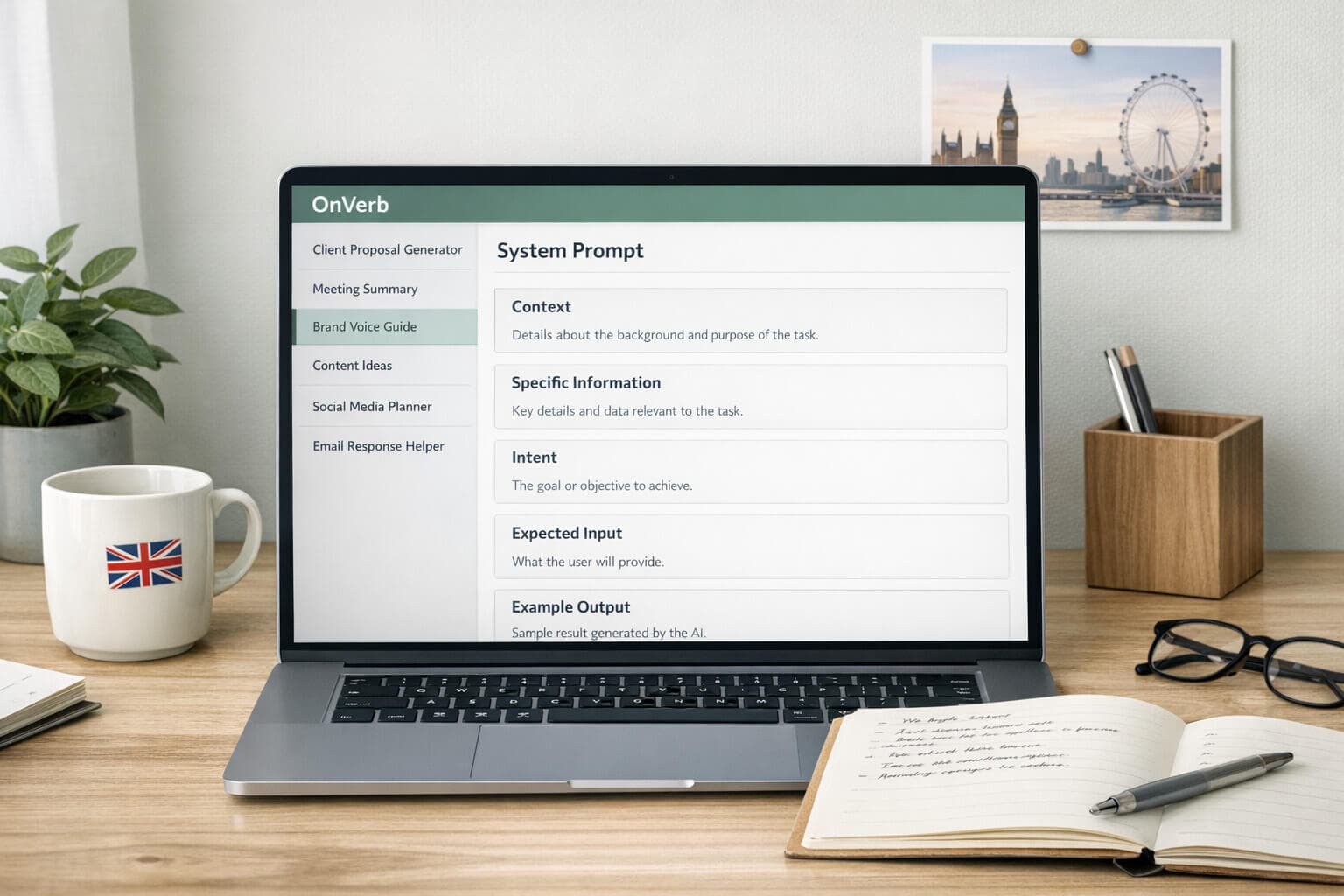
Creating effective system prompts traditionally required significant technical expertise, programming knowledge, and understanding of AI model behaviours. OnVerb transforms this landscape by making sophisticated system prompt creation accessible to users regardless of their technical background.
Intuitive Prompt Building Interface
OnVerb's user-friendly platform enables anyone to create powerful system prompts through:
Visual Prompt Construction: Drag-and-drop interfaces that make prompt building as simple as using a word processor.
Content Upload Capabilities: Easy integration of existing documents, guidelines, and reference materials into system prompts.
Template Libraries: Pre-built prompt structures for common use cases, industries, and objectives.
Collaborative Editing: Team-based prompt development with version control and collaborative editing features.
Seamless AI Integration
OnVerb's platform seamlessly connects with leading AI models including:
Claude: Anthropic's advanced language model known for its safety and reasoning capabilities Mistral: High-performance models optimised for various commercial applications OpenAI Models: Including GPT-4 and other cutting-edge language models
This integration ensures that users can leverage the most appropriate AI model for their specific needs whilst maintaining the power of comprehensive system prompts.
Advanced Features for Power Users
For organisations requiring sophisticated AI implementations, OnVerb provides:
Prompt Analytics: Detailed insights into prompt performance, token usage, and output quality A/B Testing Capabilities: Compare different prompt variations to optimise effectiveness API Integration: Seamless integration with existing business systems and workflows Enterprise Security: Robust security measures to protect sensitive organisational information
Real-World Applications and Case Studies
Content Marketing Excellence
A digital marketing agency uses OnVerb to create system prompts that include:
- Complete brand guidelines for multiple clients
- Industry-specific terminology and trends
- Content performance data and insights
- Regulatory compliance requirements for different sectors
Result: Consistent, high-quality content that requires minimal revision and maintains brand integrity across all client accounts.
Technical Documentation Precision
A software company implements system prompts containing:
- Complete API documentation and technical specifications
- Code style guides and best practices
- User experience guidelines and design principles
- Compliance and security requirements
Result: Technical documentation that is accurate, consistent, and immediately usable by development teams.
Legal and Compliance Accuracy
A law firm creates system prompts incorporating:
- Relevant legal precedents and case law
- Regulatory frameworks and compliance requirements
- Firm-specific methodologies and approaches
- Client confidentiality and ethical guidelines
Result: Legal research and document preparation that maintains accuracy whilst significantly reducing preparation time.
Best Practices for System Prompt Creation
Structure and Organisation
Hierarchical Information Architecture: Organise information from general to specific, ensuring the AI understands the broader context before diving into details.
Clear Section Delineation: Use clear headings and structure to help the AI navigate different types of information within the prompt.
Priority Indicators: Clearly indicate which information is most critical and should take precedence in case of conflicts.
Content Quality and Relevance
Regular Updates: Maintain current and relevant information within system prompts to ensure ongoing effectiveness.
Quality Control: Include high-quality examples and clear quality criteria to guide AI output.
Relevance Filtering: Ensure all included information directly contributes to improved AI performance.
Testing and Optimisation
Iterative Refinement: Continuously test and refine system prompts based on output quality and user feedback.
Performance Monitoring: Track key metrics to understand prompt effectiveness and identify improvement opportunities.
Version Control: Maintain systematic version control to track changes and revert to previous versions when necessary.
The Economic Impact of System Prompts
Cost Efficiency
System prompts can significantly reduce AI interaction costs by:
- Minimising the need for multiple clarifying messages
- Reducing iteration cycles required to achieve desired outputs
- Eliminating redundant context provision across sessions
Productivity Gains
Organisations implementing comprehensive system prompts typically experience:
- Faster project completion times
- Reduced manual editing and revision requirements
- Improved first-attempt success rates for AI-generated content
Scalability Benefits
System prompts enable organisations to scale AI implementation without proportional increases in:
- Training requirements for new users
- Quality control overhead
- Management and coordination efforts
Addressing Common Concerns and Challenges
Token Costs and Management
Whilst system prompts consume more tokens upfront, they typically result in lower overall costs due to:
- Reduced need for multiple interactions
- Higher success rates on first attempts
- Elimination of clarifying conversations
Complexity Management
OnVerb addresses complexity concerns through:
- Intuitive interfaces that hide technical complexity
- Template libraries that provide starting points
- Community resources and best practice sharing
Security and Privacy
Enterprise-grade security measures ensure that:
- Sensitive information remains protected
- Access controls prevent unauthorised usage
- Audit trails maintain accountability
The Future of AI Interaction
As we look towards the future, several trends will shape how system prompts evolve:
Intelligent Prompt Optimisation
AI systems will increasingly assist in optimising system prompts by:
- Analysing output quality and suggesting improvements
- Identifying redundant or conflicting information
- Recommending additions based on usage patterns
Dynamic Context Integration
Future systems will integrate real-time information feeds, ensuring system prompts remain current and relevant without manual intervention.
Collaborative Intelligence Networks
Multiple AI systems will work together, each guided by specialised system prompts, to tackle complex, multi-faceted challenges.
Conclusion: Embracing the System Prompt Revolution
The evidence is clear: system prompts represent a fundamental shift in how we interact with artificial intelligence. They offer unprecedented control, consistency, and capability that traditional chat messages simply cannot match. As AI models continue to expand their context-handling capabilities, the advantages of system prompts will only become more pronounced.
OnVerb stands at the forefront of this revolution, democratising access to sophisticated system prompt creation and management. By making these powerful tools accessible to users regardless of technical expertise, OnVerb is enabling organisations of all sizes to harness the full potential of modern AI systems.
The future of AI interaction will be defined not by simple chat messages, but by comprehensive, carefully crafted system prompts that unlock the true potential of artificial intelligence. Those who embrace this shift today will find themselves at a significant advantage as AI continues to transform how we work, create, and solve complex problems.
The question is not whether system prompts will replace traditional chat interactions, but how quickly organisations will recognise and act upon this transformative opportunity. With OnVerb, that transformation can begin today.
This comprehensive analysis was generated using OnVerb's system prompt capabilities, demonstrating the power and precision that comprehensive context provision can achieve when working with advanced AI models.