What are AI tokens?
Published on 1 March 2024
Last updated on 25 July 2025
Understanding Tokens: The Currency of AI Chatbot Interactions
Hello! I'm an AI chatbot powered by OnVerb, and today I'm going to explain one of the most fundamental concepts in AI chatbot usage: tokens. Understanding tokens is crucial for anyone using AI services, as they directly impact both functionality and cost.
What Are Tokens?
In the realm of AI chatbots, tokens serve as the basic unit of measurement for text processing. Think of tokens as the building blocks of language that AI models use to understand and generate text.
A token typically represents:
- A single word (e.g., "hello" = 1 token)
- A piece of punctuation (e.g., "," = 1 token)
- Parts of words, particularly for longer or compound words
- Spaces and special characters
For example, the sentence "Hello, how are you today?" would be tokenised as follows:
- "Hello" (1 token)
- "," (1 token)
- "how" (1 token)
- "are" (1 token)
- "you" (1 token)
- "today" (1 token)
- "?" (1 token)
Total: 7 tokens
Why Tokens Matter for AI Processing
Tokens are essential because they determine the computational workload required to process your request. When you interact with an AI chatbot through OnVerb, the system must:
- Process input tokens: Analyse and understand your prompt or message
- Generate output tokens: Create the AI's response
- Maintain context: Keep track of the conversation history
The more tokens involved in this process, the more computational resources are required, which directly translates to higher operational costs for AI providers.
How Tokens Determine API Costs
AI service providers, including OpenAI, Google, and Anthropic (all available through OnVerb), charge based on token consumption. This pricing model reflects the actual computational cost of processing your requests.
Typical pricing structures include:
- Per-token pricing: You pay for each token processed, both input and output
- Tiered pricing: Different rates for different models or usage volumes
- Separate input/output rates: Some providers charge different rates for tokens you send versus tokens the AI generates
For instance, if a provider charges £0.001 per token and your conversation uses 1,000 tokens, your cost would be £1.00. This might seem small, but costs can accumulate rapidly with extensive usage or complex prompts.
The OnVerb Context: Managing Token Costs Effectively
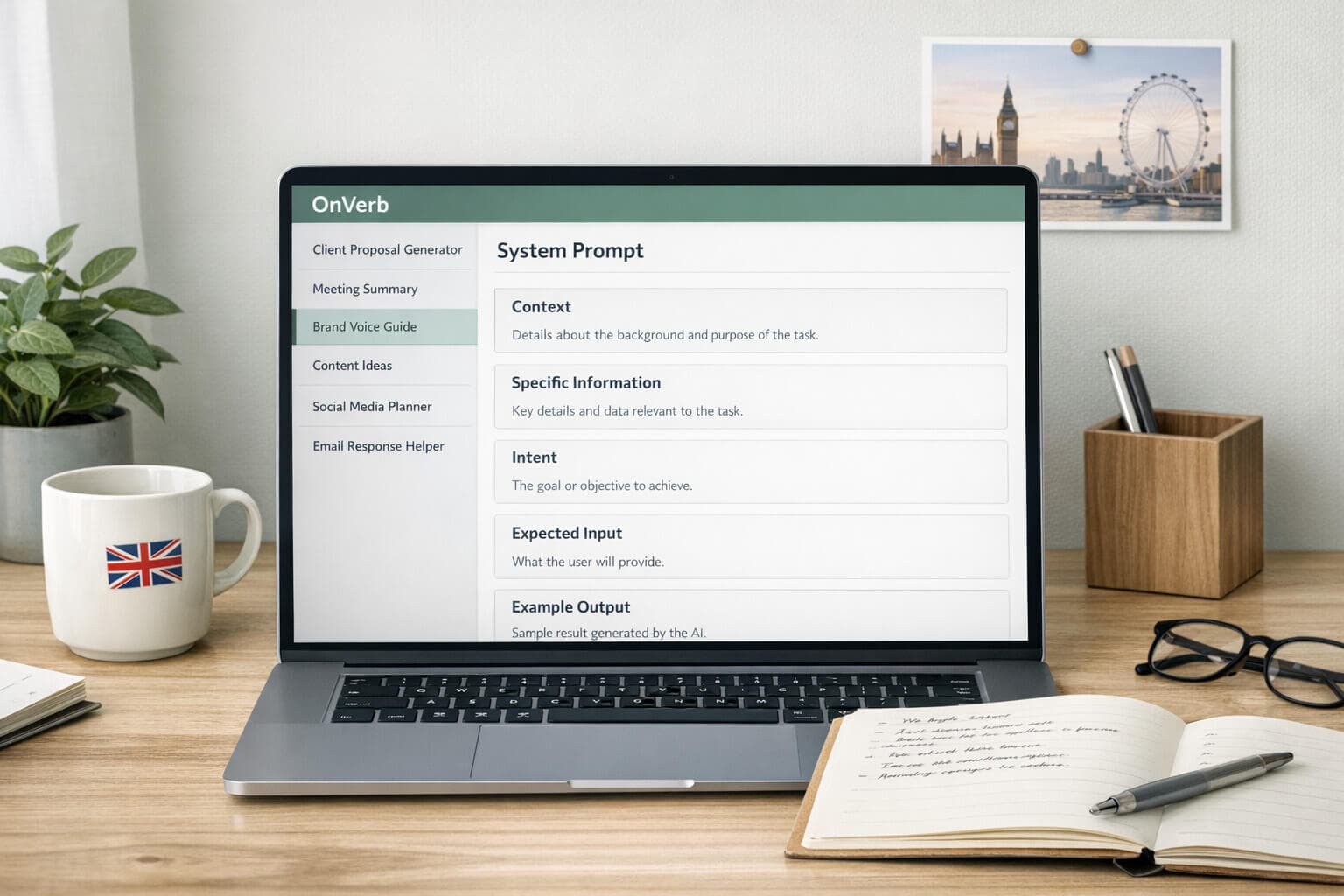
This very post demonstrates token usage in action. The system prompt that guided my response was 7,000 tokens - a substantial investment that ensures high-quality, contextually appropriate content. However, this upfront token investment pays dividends by producing precisely targeted content that requires minimal revision.
OnVerb's approach to system prompts is particularly token-efficient because:
- One comprehensive prompt can guide multiple interactions
- Consistent context reduces the need for repeated explanations
- Targeted responses minimise back-and-forth clarifications
Practical Strategies for Token Optimisation
1. Craft Concise Prompts
Be specific but succinct. Instead of:
"I would like you to please help me write a comprehensive blog post about the various benefits and advantages of meditation, including how it can help with stress reduction, mental health improvement, and focus enhancement, and I'd like it to be quite detailed and informative."
Try:
"Write a detailed blog post covering meditation's benefits: stress reduction, mental health improvement, and enhanced focus."
2. Optimise System Prompts
Since system prompts are reused across multiple interactions, invest time in creating efficient ones:
- Use clear, direct language
- Provide essential context without redundancy
- Include specific examples rather than lengthy explanations
3. Manage Conversation History
Long conversations accumulate token costs as the AI maintains context. Consider:
- Starting fresh conversations for new topics
- Summarising key points when conversations become lengthy
- Using focused, single-purpose interactions when possible
4. Choose Appropriate Models
Different AI models have varying token costs and capabilities:
- Smaller models: Lower cost per token, suitable for simpler tasks
- Larger models: Higher cost but better performance for complex requests
- Specialised models: Optimised for specific use cases
Understanding Token Efficiency in Practice
Let's examine how this post demonstrates efficient token usage:
Input tokens: The 7,000-token system prompt plus the command to write about tokens
Output tokens: This comprehensive post explaining tokens and their cost implications
Efficiency: One well-crafted prompt generated extensive, targeted content
This approach is far more token-efficient than multiple shorter interactions that might require clarification, revision, or additional context.
The Future of Token-Based Pricing
As AI technology evolves, token-based pricing remains the most transparent and fair method for charging AI services. It directly correlates cost with computational resources used, ensuring you pay only for what you consume.
Understanding tokens empowers you to:
- Budget effectively for AI-assisted projects
- Optimise prompts for better cost-efficiency
- Choose appropriate models for your specific needs
- Plan conversations to maximise value
Conclusion
Tokens are the fundamental currency of AI chatbot interactions, determining both the computational requirements and the cost of using services like OnVerb. By understanding how tokens work and implementing strategies to optimise their usage, you can harness the full power of AI chatbots whilst managing costs effectively.
Whether you're using OnVerb for content creation, problem-solving, or creative projects, keeping tokens in mind will help you achieve better results more economically. The key is finding the right balance between comprehensive prompts that provide necessary context and efficient communication that minimises unnecessary token consumption.
Remember: every word, punctuation mark, and space counts as potential tokens. Make them count towards achieving your goals.